
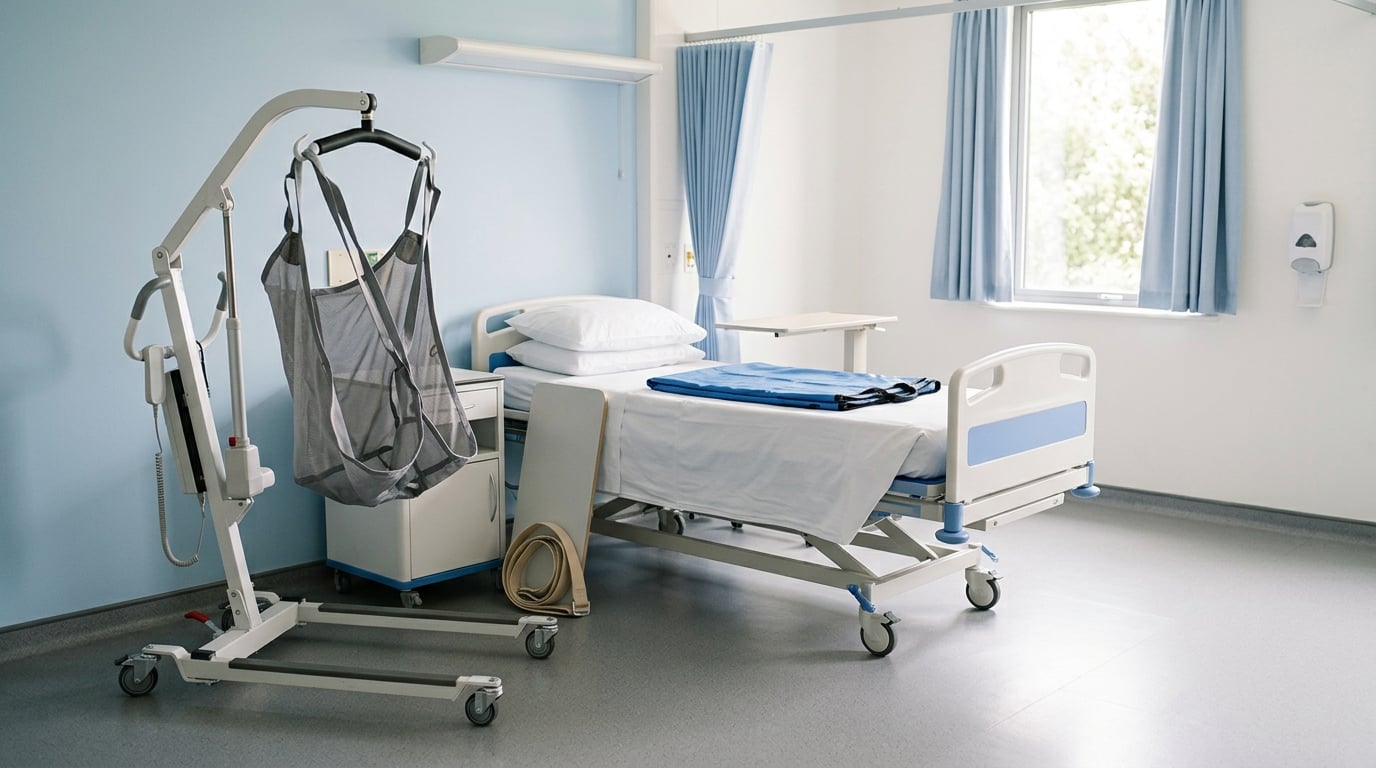
Ergonomics for nurses and patient handling means matching the care task, the patient, and the equipment so the nurse’s body never has to absorb force it was not built to carry. In practice, safe patient handling and mobility (SPHM) is an assessment-and-equipment discipline, not a lifting-technique discipline. The safest move is the one planned before anyone grips anything.
That shift in thinking matters more than any single technique. Decades of manual lifting did not produce a generation of nurses with strong backs, they produced a generation of nurses with shoulder, neck and lower-back problems. Below is what the evidence supports, how to run a move safely, what equipment exists, and what to do when the shift goes sideways.
Everything here is general safety information, not medical advice. If you are already hurting, or develop numbness, weakness, or pain that does not settle, report it and get evaluated by a clinician or your occupational health team rather than working through it.
Table of Contents
- What Is Ergonomics for Nurses and Patient Handling?
- Why Do Nurses Need Ergonomics for Patient Handling?
- How Can Nurses Reduce Strain When Moving Patients?
- Which Patient-Handling Equipment and Assistive Devices Help?
- How Do You Safely Reposition a Patient in Bed?
- How Do Nurses Protect Their Back and Shoulders at Work?
- How Can Healthcare Facilities Improve Nursing Ergonomics?
- What Should Nurses Do When a Lift or Transfer Feels Unsafe?
- Frequently Asked Questions
- What are the OSHA guidelines for safe patient handling?
- What are the 5 principles of ergonomics?
- What are the 7 ergonomic hazards in nursing?
- What are the 7 safe principles of moving and handling?
- What does California require for safe patient handling?
- Does safe patient handling actually reduce nurse injuries?
- Conclusion
What Is Ergonomics for Nurses and Patient Handling?
Ergonomics is the study of the fit between a person, a task, and the environment. Applied to nursing, that fit is where the bed height meets your shoulders, where the supply room is in relation to the room, and whether the sling you need is on the unit or three floors away.
Patient handling and mobility sits at the centre of that work because it is the single most physically demanding thing bedside nurses do. Lifting, transferring, and repositioning involve unpredictable load, awkward arm positions, twisting under a moving centre of gravity, and repetition dozens of times a shift.
Four factors decide how much strain a task creates: how much force is required, how awkward the posture is, how many times you repeat it, and how much contact pressure or shearing runs through your body and the patient’s skin. A safe handling plan attacks all four. Technique alone attacks none of them reliably, because a person’s spine does not care how well you braced.
Why Do Nurses Need Ergonomics for Patient Handling?
Because the hazard is not care itself, it is the load. Survey data cited throughout the occupational safety literature from the mid-2010s, including an American Nurses Association survey of roughly 5,000 nurses, found 62% named musculoskeletal disorders as a top concern, and 34% of hospital nurses reported back, neck or shoulder pain. Of those affected, 84% said a work-related back injury limited their movement. Older analyses put the share of nurses who leave the profession because of chronic lower back pain in the 12% to 18% range.
Those figures are dated, and the framing has moved on from counting injuries to building prevention programmes. What has not changed is the mechanism. Nurses absorb load that belongs to a machine.
Most back and shoulder trouble in nursing comes from a short list of repeating motions. Repositioning a patient up in bed drags the body through the sheets, which creates friction and puts shear through the spine. Lifting from the floor or from an awkward height compresses the disc and loads the lumbar spine. Twisting under a moving patient adds rotational force on top of all of it. Bed baths, toileting, and perineal care push you into the worst possible posture, crouched over a mattress, arms extended, with a patient who may shift without warning.
Most of that is foreseeable, and that is the frustrating part. The body is excellent at absorbing occasional load and poor at absorbing the same load four hundred times a year.
Normal tiredness fades by the time you get home. Warning signs do not: pain that wakes you, numbness or tingling in a hand, grip strength dropping on one side, or a shoulder that aches at rest. Those belong in an occupational health referral, not in a shift you finish on your own.
How Can Nurses Reduce Strain When Moving Patients?
Reduce strain by changing the plan before the move, not your body during it. This is the sequence most SPHM algorithms follow.
- Assess the patient first. Know the dependency level, whether the patient can follow commands, whether they can bear weight, and whether the skin condition or a recent surgery changes the plan. Check for lines, drains, catheters and tubes that a move will pull on.
- Assess the environment. Bed to the correct working height, brakes on, wheels unlocked, bed moved close to the chair or stretcher, side rails and the call light within reach, floor clear of cords and equipment, and the space around the bed cleared.
- Decide the destination before you touch the patient. Commode or chair positioned on the strongest side of the patient, the one they use for pushing up when getting out of bed.
- Choose the device and the number of caregivers. A dependent patient needs a mechanical lift and enough trained staff. A cooperative patient who bears weight may need one caregiver and a gait belt. A high-dependency patient needs equipment rated for the actual load, checked before every use.
- Set up the room before you move the person. Get the lift, the sling, the sheet, the chair and the footwear positioned first. Most handling injuries trace back to a mid-move scramble for a missing item.
- Execute as one coordinated motion. Short count, one person leads, nobody twists their spine or reaches across the bed. Keep the load close to your body and keep your feet planted rather than stepping or spinning under load.
- Reassess at the halfway point. Skin, positioning, tube security, and the patient’s comfort, before continuing.
- Stop if it stops working. If the load shifts, someone feels the pinch, or you would not attempt this again in ten minutes, pause and get more people or a different device. Never finish a bad lift halfway because stopping feels like admitting something.
If you have to be the one person who stops a move, you are the one person who can prevent the injury. That is not asking for help, it is the job.
Which Patient-Handling Equipment and Assistive Devices Help?
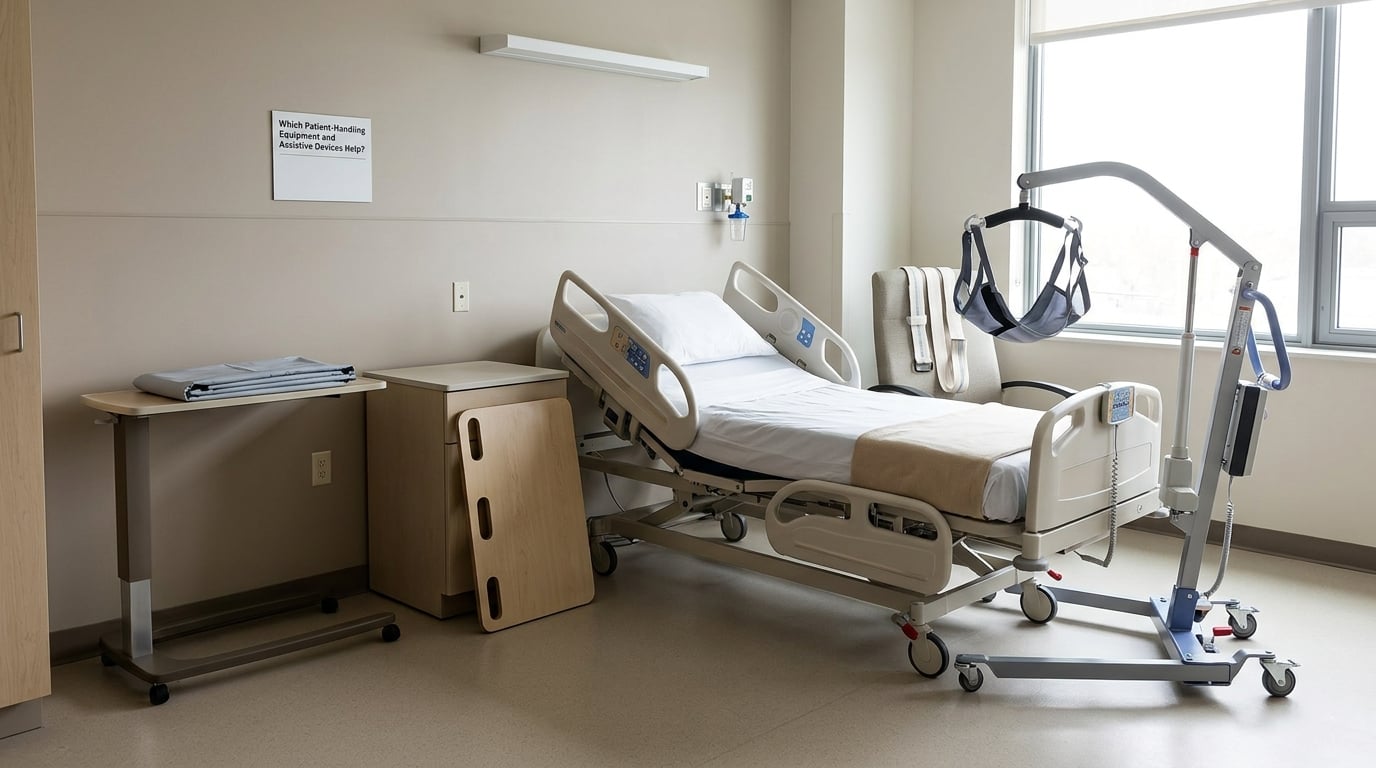
Equipment is the intervention with actual evidence behind it. It spans a wide range, and the right pick depends on the patient’s dependency and the direction of the move.
| Device | Best used for | Caregivers typically needed | Main limitation |
|---|---|---|---|
| Gait belt | Short, cooperative transfers and sit-to-stand with partial weight bearing | One, sometimes two | Not for a patient who cannot bear weight or who has fragile skin |
| Friction-reducing sheet or slide sheet | Repositioning up in bed or side to side without lifting | One to two | Requires strength to control the slide, so it is not a no-lift device |
| Transfer board | Lateral transfers for patients with limited upper-body control | Two to three | Needs shoulder clearance and a low-friction surface |
| Sit-to-stand or stand-assist lift | Getting a patient from bed or chair to standing | One, sometimes two | Requires some weight bearing and good floor clearance |
| Powered floor or ceiling-mounted sling lift | Full lifts, bariatric loads, non-weight-bearing patients, toileting and bathing | One, with a second for awkward or high-dependency moves | Sling selection and fit matter more than the lift itself |
| Transfer chair | Long moves down a corridor or between units | One to two | Not a lifting substitute, still a manual handling task |
| Height-adjustable bed | Nearly every bedside task | n/a | Only helps if staff actually adjust it rather than work around the default |
Two things about this equipment are worth being blunt about. First, capacity ratings are not suggestions, and a sling or lift that is not rated for the patient’s actual weight is a hazard to both of you. Second, gear does not cancel training: a badly fitted sling does more damage than no sling, and a powered lift operated without training is a projectile.
Practitioners also report a real cost that policy documents rarely mention. Equipment is widely described as helpful but time consuming and awkward to implement at times, particularly when room layout is poor or the device is not on the unit. That is a workflow problem, not a motivation problem, and it is one of the easiest things for a unit to fix.
How Do You Safely Reposition a Patient in Bed?
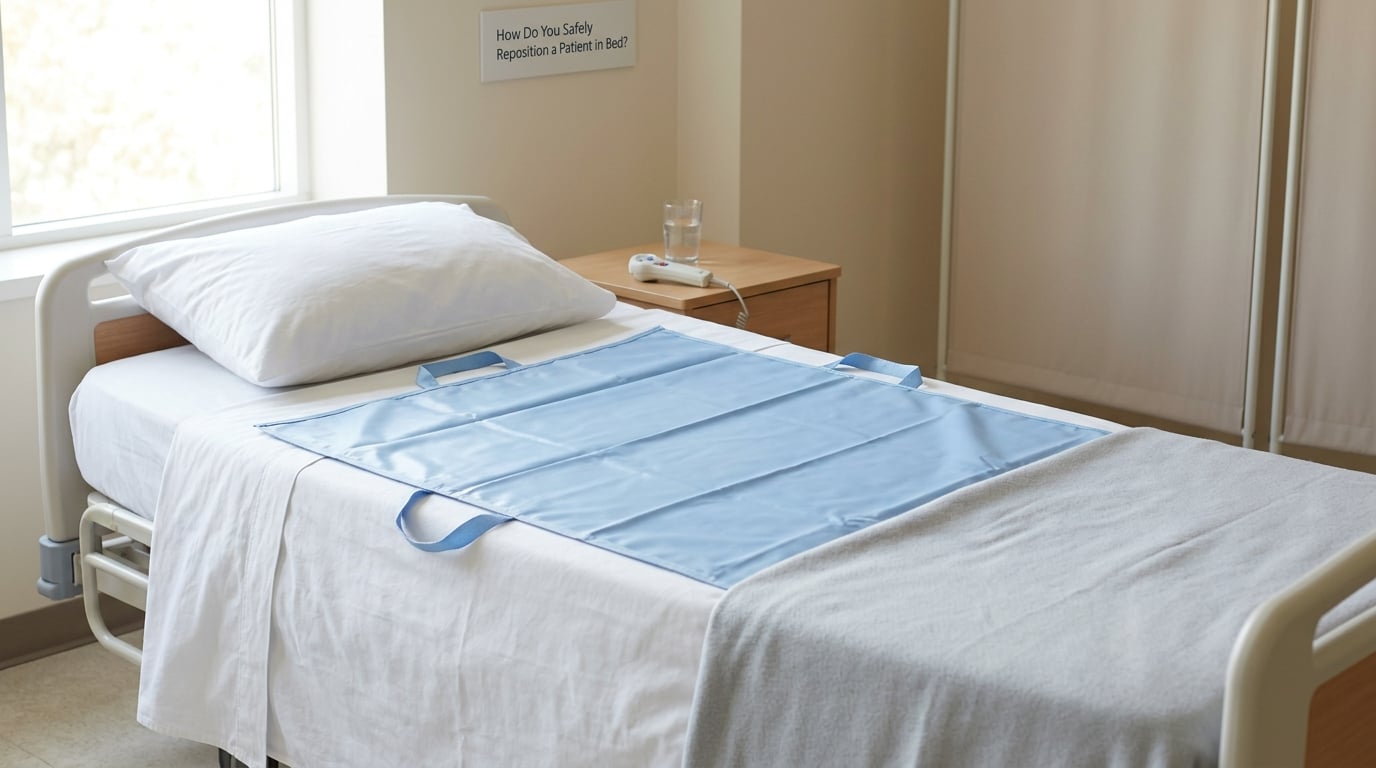
Repositioning is the move nurses do most and plan least. A patient who cannot roll needs a device and a second pair of hands. A patient who can roll onto their strong side needs a plan, a call light within reach, and a bed rail consideration that matches their actual status, not a habit.
For a patient who can assist, set the bed to a height where their feet stay flat on the floor, lock the brakes, put the call light and water in reach, and use a gait belt or friction-reducing sheet if they still need pulling assistance. Ask them what side they manage, and let them lead with their arms and legs while you guide the hips and shoulder rather than hauling the whole trunk.
For a patient who cannot assist, do not do this solo by muscle effort. Use a powered lift or enough caregivers with a friction-reducing sheet, keep the number of people matched to the dependency level, and confirm the sling is the right size before you connect it.
Stop and reassess when the patient resists, panics, or shifts suddenly, when a line pulls, when skin shows shear or reddening under pressure, or when the pillow, tube or drain is caught. Reassess at least every two hours for a patient who cannot move themselves, and follow your facility’s pressure injury prevention policy, which will set its own schedule and device requirements.
Repositioning also protects the patient, not only you. Controlled moves reduce skin tears, pressure injury risk, and the sudden tugs that start a fall on the way to the bathroom.
How Do Nurses Protect Their Back and Shoulders at Work?
Your back is not the weak link in this system, so stop treating it as the solution. Lift-with-your-back training tells you how to brace and lift. It does not remove the load, and it does not survive contact with a 100-kilogram patient who moves without warning. Shoulder load is the quieter problem: reaching across a wide bed, holding a patient’s arm during a bath, and pushing a stiff bed all concentrate stress on the rotator cuff.
Most of the useful protection is boring and free.
- Set the bed height every time. Elbows near 90 degrees for most bedside work. Bed height is the cheapest ergonomic control in a hospital and the one most often skipped.
- Step up, don’t bend over. A step stool at the bedside prevents the deep lumbar flexion that starts most of these injuries.
- Keep the load close and your feet planted. Moving your feet beats twisting your spine, every time.
- Fix the workstation. Charting at shoulder height with the monitor directly in front of you, and a chair that actually supports your lower back. Cursoring across a screen for a shift produces the same category of injury as a bad transfer.
- Handle PPE deliberately. Donning and doffing gowns, masks and eye protection loads the shoulders, and hurried repetition adds to it.
- Wear supportive non-slip footwear. Falls and slips are a common injury mechanism in nursing, and a hospital floor plus a foam clog is a bad combination.
- Recover deliberately. Rotate duties, take your breaks, and build strength in your hips, legs and core rather than trying to strengthen a lumbar spine against a 90-kilogram load.
If you are new to the floor, the habits you form in your first year are the ones you will keep for thirty. That makes the first year the most important one to get right.
How Can Healthcare Facilities Improve Nursing Ergonomics?
Individual technique cannot fix a system that has one lift for twenty beds. Ergonomics in nursing is an employer responsibility first and a personal practice second, which means the practical improvements all sit with management and safety committees.
A functioning safe patient handling and mobility programme contains: a written no-manual-lift policy, patient assessment algorithms, sufficient equipment of every type including bariatric-rated capacity, staff training on the actual devices, regular equipment inspection and maintenance, bed height standards, and a route for staff to report hazards without fear. The American Nurses Association has run its Handle With Care campaign since 2003 and published interprofessional SPHM standards, and the QSEN safe patient handling curriculum teaches exactly this two-step model: assess the patient and environment, then pick the device and caregiver count from the algorithm.
On regulation, there is no federal OSHA ergonomics standard for healthcare. OSHA applies the general duty clause, which requires employers to address recognized serious hazards, and states such as California have gone further with specific safe patient handling law. California was the first, with AB 1135 in 1999, and Cal/OSHA regulation section 5203 covers non-general acute care hospitals, requiring a programme with equipment, training, staffing plan and incident investigation. Requirements differ by state and by facility type, so the specific rules for your workplace come from your state agency and your own policy.
What nurses can do is concrete. Track near misses in the incident reporting system, ask for the injury rate by unit rather than by hospital, and frame the ask around patient outcomes such as falls and skin tears, which managers feel more than caregiver strain. Peer-to-peer debate on social media fills the gap left by weak policy, and it is not a substitute for equipment.
What Should Nurses Do When a Lift or Transfer Feels Unsafe?
When a transfer feels unsafe, stop the transfer. That is the whole professional answer, and the rest is just how to do it without regretting it.
First, do not complete a move that is already going wrong. Lower the person to the nearest safe surface, a bed, a chair, the floor with protection, and get the patient stable. Then call for help, and be specific: which unit, what room, what is needed, a lift or a fourth person.
Protect the patient while you wait. Untangle lines, release a grip, stop a swing. Then document it: the task, the device used or missing, the staffing level, the number of caregivers available, and what almost went wrong. Near-miss reports are the single most useful data a unit has, and they only exist if you file them.
Then tell someone beyond your manager when your body is involved. Report pain, numbness, or weakness through the same channel you use for a patient event, and follow up with occupational health. Early reporting changes the management; late reporting tends to change the diagnosis.
Finally, separate what happened from what you did. A transfer that goes wrong on a short-staffed shift with unavailable equipment is a systems problem, and near-miss reporting is the mechanism that surfaces it. Framing matters because a nurse who believes a report will be used against them will stop filing, and the next injury will be a real one instead of a close call.
Frequently Asked Questions
What are the OSHA guidelines for safe patient handling?
There is no federal OSHA ergonomics standard specific to healthcare. OSHA applies its general duty clause, which requires employers to address recognized hazards that can cause death or serious physical harm, including patient-handling injuries. Individual states have gone further: California requires covered non-general acute care hospitals to maintain a written safe patient handling programme with equipment, training, staffing plans and incident investigation. Always check your state agency’s rules and your own facility policy for the requirements that apply to your workplace.
What are the 5 principles of ergonomics?
The five core principles are: eliminate unnecessary manual work, keep the body in a neutral posture, keep loads light and close to the body, reduce repetition and awkward reaching, and match the tool to the task. In nursing they translate to designing care so fewer manual lifts happen, working at a bed height that lets you keep elbows near 90 degrees, using a mechanical lift instead of your spine, and treating a device or an extra caregiver as the correct answer rather than an exception.
What are the 7 ergonomic hazards in nursing?
The recurring ergonomic hazards in nursing are: patient lifting and transferring, awkward and twisted postures, repetitive motion such as repeated repositioning, static posture at workstations and during charting, physical environment problems including poor bed height, room clutter and equipment layout, contact pressure and shear on the patient’s skin during friction-heavy moves, and organisational factors such as understaffing, rushed work and inadequate equipment. The last one drives the other six.
What are the 7 safe principles of moving and handling?
A widely used set of moving and handling principles is: assess before you act, avoid unnecessary handling, plan the move so the destination is ready, use the safest and most appropriate equipment available rather than the smallest, apply the minimum effective force, get the right number of trained caregivers for the patient’s dependency, and stop if the move is not working. Communication between the team is built into each step rather than treated as a separate one.
What does California require for safe patient handling?
California was the first state with a safe patient handling statute, passing AB 1135 in 1999. Cal/OSHA regulation section 5203 requires non-general acute care hospitals to implement a programme that includes written policies, appropriate lifting and transferring equipment, staff training, a staffing plan for safe handling, and a process for reviewing handling-related incidents and injuries. General acute care hospitals are covered through California’s general injury and illness prevention requirements instead, so the detail depends on your facility type.
Does safe patient handling actually reduce nurse injuries?
The evidence points to yes, with an important caveat. The strongest gains come from programmes that combine no-manual-lift policies, adequate mechanical equipment, and training on the specific devices in use. Lift-with-your-back training on its own has not shown a reliable effect, because technique cannot remove a load that exceeds what a spine tolerates. The limitation most teams report is adherence: equipment that is slow to fetch or awkward in a cramped room tends not to be used consistently.
Conclusion
Start with the task, not your back. Assess the patient and the room, decide the equipment and the number of caregivers before anyone grips, and use trained help and a suitable device rather than manual force. When a move feels wrong, stop and secure the patient. And when you have pain, numbness or weakness, report it early to your occupational health team or a clinician instead of pushing through a shift.